
What is Punch needle?

punch needle is not just an embroidery technique, but a journey through time, culture, and creativity. From its ancestral roots to its current rise as a popular artistic activity, this technique has fascinated generations with its simplicity and versatility. Join us as we discover the history and origins of punch needle, its evolution, and the key figures who have shaped its legacy.
History and origins of punch needle: an ancient art.
The origins of punch needle date back to ancient civilizations. Evidence of this technique has been found in Egyptian artifacts, where hollow bones were used as needles to create designs in fabric. These primitive tools laid the foundation for what would become a global art.
In the 15th century, the punch needle stitch gained popularity in Europe under the name "punch stitch." Its primary use was for decorating religious garments and textiles, combining functionality and artistry. Interestingly, it wasn't exclusively a women's activity: sailors practiced it during long voyages to create rugs and alleviate the tedium of the sea.
Birth of punch needle in the 19th Century in Great Britain.
According to author William Winthrop Kent, the punch needle was born in the 19th century in Great Britain, at the dawn of the Industrial Revolution. During this period, the bourgeoisie began to decorate their homes with expensive carpets produced in specialized factories.
The origin of this technique lies in a carpet factory in Yorkshire, Great Britain, where workers were allowed to collect leftover wool scraps to take home. These fragments of wool, known as thrums, measured approximately 23 cm (9 inches) and were used to make their own carpets. Using a simple wooden-handled hook, they passed these threads through a scrim, thus creating coverings for their homes.

With emigration to the East Coast of the United States and Canada, this artisanal technique spread, becoming a popular solution for the poorest homes that needed to cover their rudimentary floors. During the 19th century, many homes had hastily assembled softwood floors, and rugs made with punch needle proved to be a more aesthetically pleasing and affordable alternative to the commonly used mats made of coconut fiber, straw, or corn husks.
Since quality threads and fabrics were expensive and usually reserved for clothing, women began reusing scraps of fabric to make rugs. What began as a necessity transformed into a form of creative expression.
19th Century: The Rise of Rug Hooking.
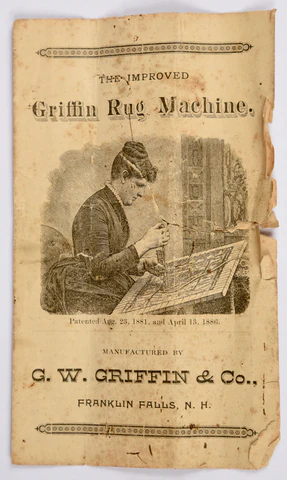
Beginning in 1830, industrial carpet production began to expand, and by 1870, the industry was producing carpets in large volumes for the lower class. However, despite mass production, rug hooking remained a household craft. What began as an essential household task soon evolved into a hobby and an art form.
The Rug Hookers: From Necessity to Art.
At the end of the 19th century, rug hooking experienced a major breakthrough with its introduction in North America. In 1886, Ebenezer Ross of Toledo, Ohio, patented the first rug hooking tool, called "The Griffin." This innovation revolutionized rug making, allowing the fabric to be perforated from the back instead of being woven from the front.
As living standards improved during the Industrial Revolution, the materials and techniques of rug hooking also evolved. Artists known as rug hookers emerged, who began designing and handcrafting rugs to order. Beginning in the 1930s, these artists promoted the popularization of rug hooking by publishing their work and establishing formal guidelines for the practice, elevating it to a recognized art form.
Thanks to this faster and more accessible technique, specialized studios sprang up on the East Coast of the United States and Canada. By the 1930s and 1940s, handmade punch needle rugs became a symbol of luxury, decorating the homes of movie stars, politicians, and even museums like the Metropolitan Museum of Art and the Smithsonian.

Global variants: Russia and Japan.

Igolochkoy: the Russian punch needle.
While rug hooking dominated in North America, other countries developed their own versions of rug hooking. In Russia, Igolochkoy emerged, a miniature embroidery technique characterized by its intricate relief designs. This technique was discovered in the United States in the 1970s by Jean Cook Anderson, who observed it among Russian Old Believers in Oregon.
Bunka Shishu: the Japanese style.
In Japan, bunka shishu emerged as a form of embroidery that used fine threads to create detailed, painting-like images. Unlike rug hooking, this style focused on precision and realism, demonstrating another aspect of the versatility of this craft technique.
Modern innovations: the Oxford needle.

The punch needle continued to evolve with new tools and techniques. In 1995, Amy Oxford transformed the world of punch needle by inventing the Oxford Punch Needle, a tool designed for greater comfort and efficiency. Her impact was such that, in addition to improving the technique, Oxford became one of its biggest advocates through workshops and educational courses.
The Renaissance of punch needle on Social Networks.

In recent years, platforms like Instagram and Pinterest have fueled a resurgence of punch needle. Artists like Rose Pearlman, Bookhou, and Monika Danowska have taken this technique to new heights, combining traditional patterns with contemporary and abstract designs.
Thanks to this digital exhibition, a new generation of creators has discovered punch needle, exploring its artistic potential and adapting it to decoration, fashion, and modern art.
Why is punch needle still so popular?
The appeal of punch needle lies in its accessibility and versatility. From rugs and tapestries to clothing and accessories, this technique allows for creative expression while connecting with a centuries-old tradition.
Its resurgence proves that, despite being an ancient art, punch needle continues to evolve and find its place in the modern era. So, why not try your own punch needle project? Not only will you be creating something beautiful, but you'll also be part of a history that has endured through the centuries.
Photos courtesy of LIFE magazine and Amy Oxford.
 instagram
 Youtube